
Why Your Organization Feels Overloaded Even with Good People
How Organizations are Like Suitcases
I was trying to close my carry-on when it stopped cooperating.
I had everything I needed for the trip. Then I added a few more things. Nothing unreasonable — just a couple of extra items.
But when I tried to zip it up, it wouldn’t budge.
I pushed. I squashed. I sat on it, and lay on it like it would change the law of physics.
No luck. It was too full.

Every suitcase has limits.
And so does every organization.
This is a lesson I somehow managed to overlook for decades. Somehow, I managed to overlook the reality that much of leadership decision-making is fundamentally about trade-offs.
As a creator and catalyst, I was always thinking about opportunity and adding.
Many leaders are optimists. It’s good to be an optimist. Teams need leaders who see the best in people and have a hopeful future.
Leaders think about the future. They imagine what could be. They look for ways to move people forward.
No one’s inspired by a leader who walks into the room, shoulders slumped, and sobs, “Let’s lower expectations and prepare for disappointment.”
Optimism fuels leadership.
But it also creates blind spots.
Optimistic leaders tend to believe there’s always room for one more thing. One more initiative. One more program. One more opportunity that feels too good to pass up.
I once worked with a leader who described himself as a “smorgasbord leader.” He loved adding things to the table so people would have more options.
It sounded great in theory. But in reality, it created an overflowing suitcase.
Because organizations face constraints. Like suitcases, constraints don’t magically expand. They aren’t like Mary Poppins’ bag, where you can draw out anything you want.

Organizations have limits.
There’s only so much money. Only so many staff hours. Only so much attention and energy. Even volunteers come with a cost. Someone has to recruit them, train them, manage them, and follow up with them.
Eventually, you hit capacity.
And when you do, adding something new doesn’t just sit neatly on top of everything else. It creates pressure across the entire system.
Something starts to give.
The Suitcase Mindset
Addressing the suitcase mindset requires remembering the impact of addition:
When you add something, you end up taking away from something else.
It might not be obvious right away. Nothing falls out of the suitcase immediately. But over time, the sides start to bulge.
Take a leader and the suitcase she is carrying (see diagram below).
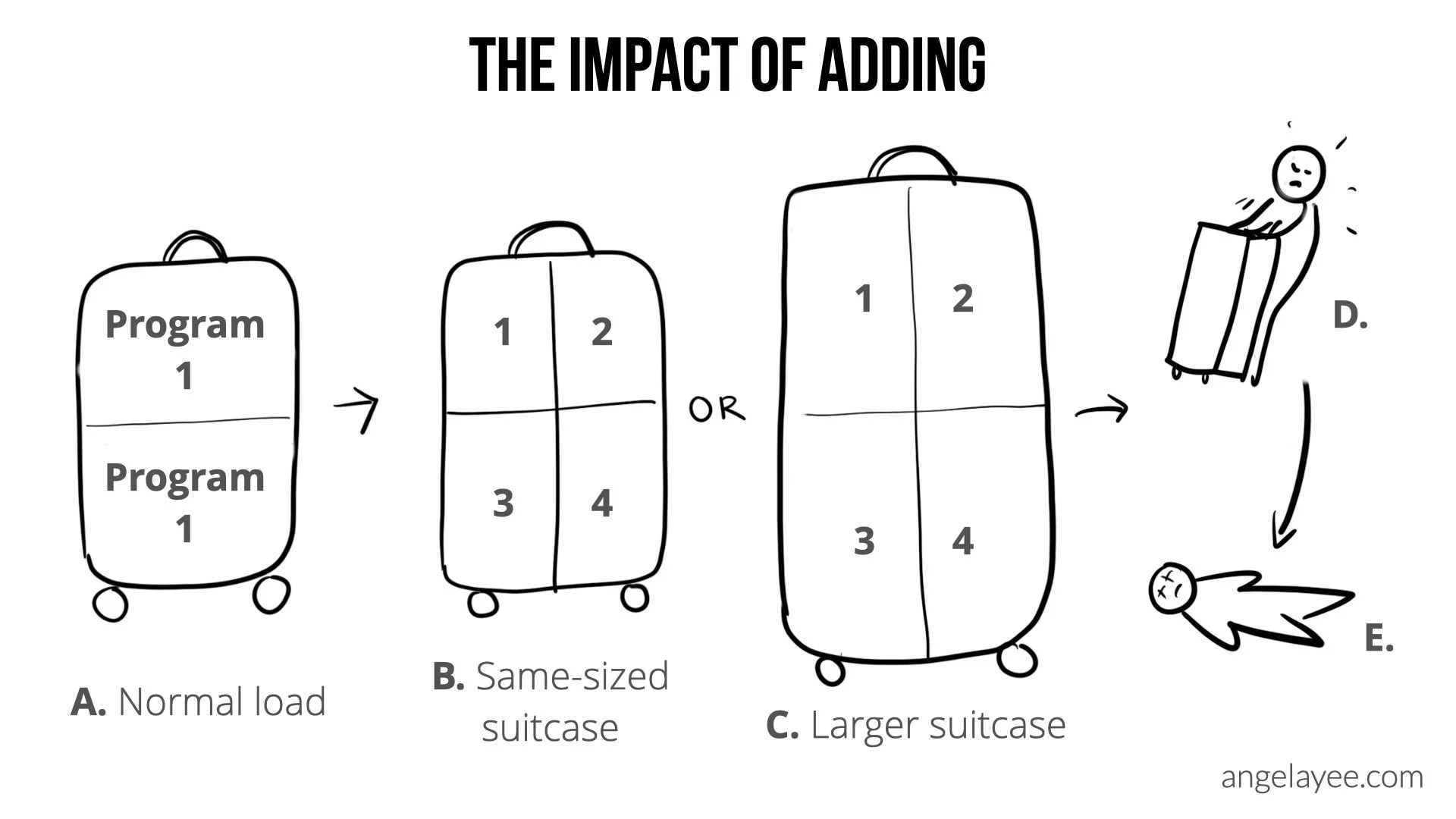
This leader already has two different programs she is running (A).
But add two new programs, and that means the original ones get reduced focus (B), 50% smaller.
The other alternative is that to keep all four programs running at the same capacity, she could get a bigger suitcase, i.e. devote more hours in her day (C).
But that suitcase gets heavier and heavier (D).
Over time, her body says,” That’s enough!” The result is stress, discouragement, and burnout — or the hospital (E).
I’ve seen this unmeasured addition often in churches and nonprofits. New ministries and programs get added year after year. Each one started with good intentions. Each one met a real need.
But no one stopped to ask what should come out of the suitcase.
The result is that everything just… exists. Nothing thrives. And resources of people, energy, and finances gradually get depleted.
It’s not because people didn’t care.
It’s because everything was spread too thin.
Subtraction savviness
So why don’t leaders subtract more?
Because subtraction is hard.
When you try to remove a program or end an initiative, someone will be disappointed — sometimes, very disappointed! People have history, relationships, and emotional investment tied to what exists.
So leaders avoid it. It’s way easier to keep adding instead.
It feels more positive to keep things going in the moment. But it doesn’t actually solve the problem. It delays it.
Because eventually, people will be unhappy anyway. Either because resources are too thin, or because the organization isn’t making the impact it set out to make.
Strong leaders choose to live in the tension of trade-offs.
They understand that every decision carries a trade-off. When something is added, a nicely packed suitcase turns into one where existing items are pressured, impacted or squeezed.

Picking one thing means not picking another. Focus requires saying no, not just saying yes. And that sometimes means ending things. To create space for something new, something else must be let go.
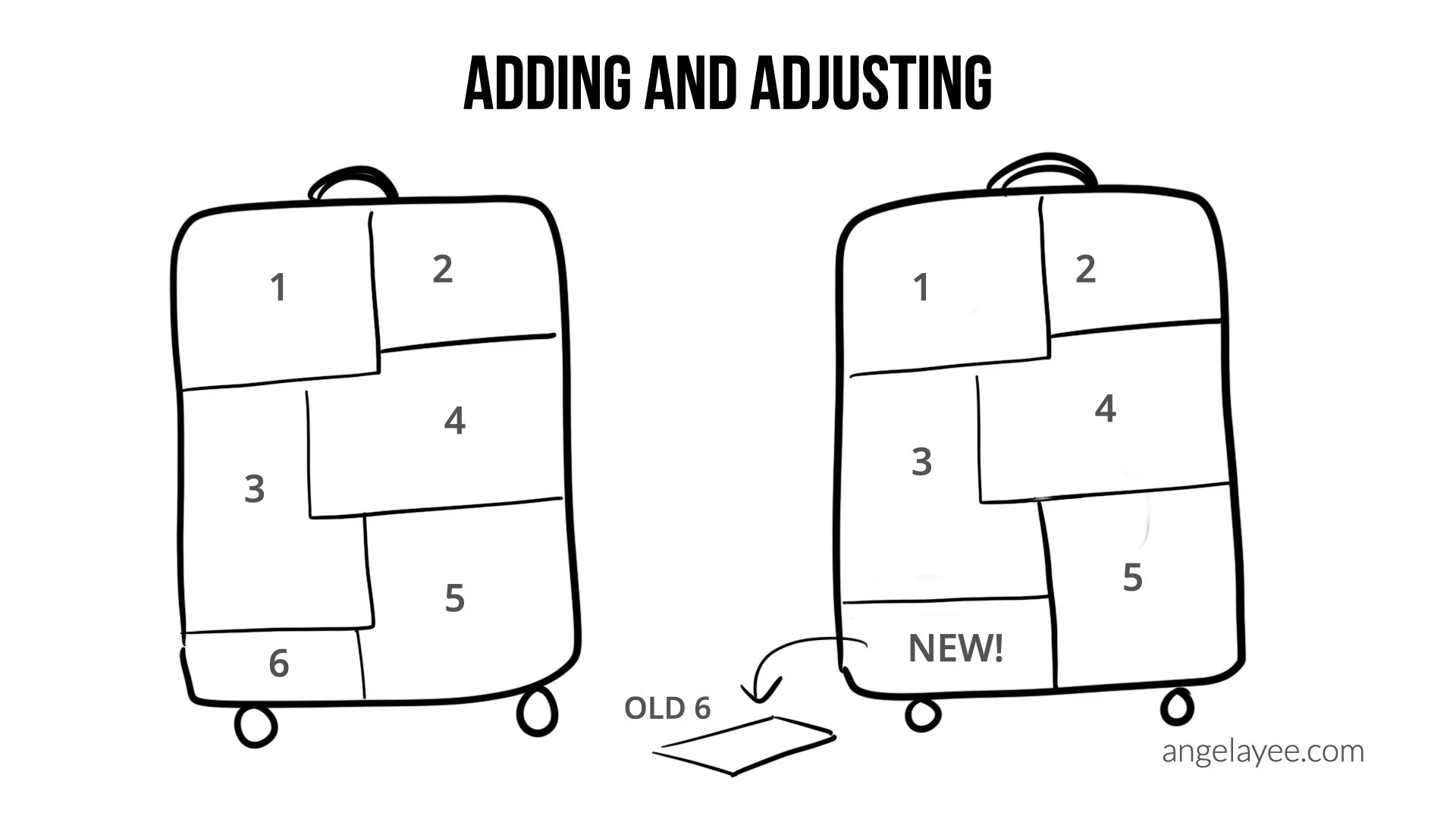
Leaders with subtraction savviness don’t just ask, “What should we add?”
They also ask, “What are we willing to stop?”
If you’re putting something into your suitcase, something has to come out.
Because they realize this dynamic, before putting anything in the suitcase, ask, “What impact will adding this make, and how will areas be affected?
Practical takeaway
List everything your team or organization is currently carrying — all programs, initiatives, and priorities.
Identify your top 3–5 areas that matter most for your mission and impact.
For every new idea or opportunity, ask: what are we willing to remove or reduce to make room for this?
Choose one thing to stop, pause, or scale back this quarter. Start small if you need to. The goal is to build the muscle of subtraction.
Because at the end of the day, leadership isn’t about how much you can fit into the suitcase.
It’s about choosing what’s actually worth bringing along.